Shixian Liu
Phonon transport · Micro- and nanoscale heat conduction
I am a Ph.D. candidate and Assistant at Bauman Moscow State Technical University, Moscow. I study phonon transport and heat conduction in nanostructures and low-dimensional materials.
My work uses molecular dynamics, lattice dynamics, machine-learning interatomic potentials, and Monte Carlo solutions of the phonon Boltzmann transport equation.
News
All news- Our work on wave–particle phonon transport received a Bauman MSTU award for scientific papers published in 2025.
- Best Poster Award at PTES 2026 and the 10th Workshop on Thermal Transport, Harbin.
- Our work on quantifying particle and wave contributions to phonon transport in pillared graphene nanoribbons was featured by Advances in Engineering.
Selected publications
All publications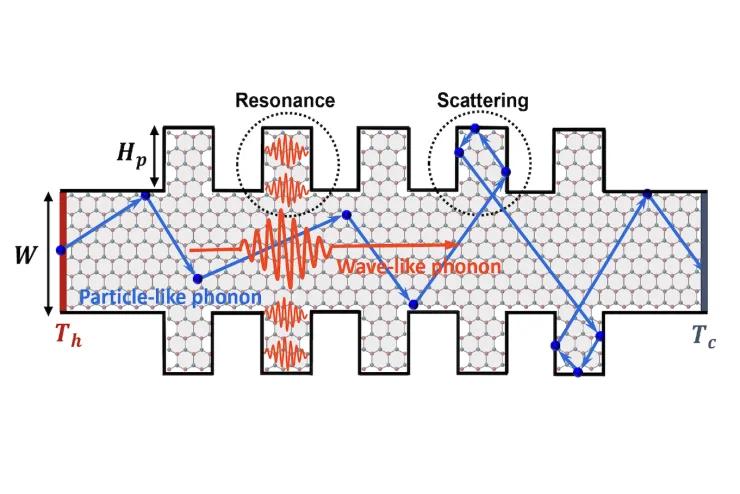
Quantifying Particle and Wave Effects in Phonon Transport of Pillared Graphene Nanoribbons
International Journal of Thermal Sciences, 2025, Vol. 217, 110067
- IF 5.0
- JCR Q1
- Scopus Q1
Abstract
This study investigates the dual nature of phonons—encompassing both particle-like and wave-like behaviors—and their roles in thermal transport within pillared graphene nanoribbons (PGNRs). Monte Carlo simulations are employed to evaluate how the presence of pillars affects the thermal conductivity of graphene nanoribbons (GNRs), revealing that pillars significantly reduce thermal conductivity by enhancing phonon-boundary scattering, thereby emphasizing particle effects. A comparison with molecular dynamics simulations enables quantitative assessment of the respective contributions of particle and wave phenomena to the observed reduction in thermal conductivity. Notably, as the width of PGNRs decreases, the influence of wave effects initially increases and then diminishes, suggesting a saturation behavior. Furthermore, this study introduces and evaluates the concept of phonon resonance hybridization depth in PGNRs.
BibTeX
@article{shixian2025wave,
  author={Liu, Shixian and Zong, Zhicheng and Yin, Fei and Khvesyuk, V.I. and Yang, Nuo},
  title={Quantifying Particle and Wave Effects in Phonon Transport of Pillared Graphene Nanoribbons},
  journal={International Journal of Thermal Sciences},
  volume={217},
  pages={110067},
  year={2025},
  doi={10.1016/j.ijthermalsci.2025.110067}
}
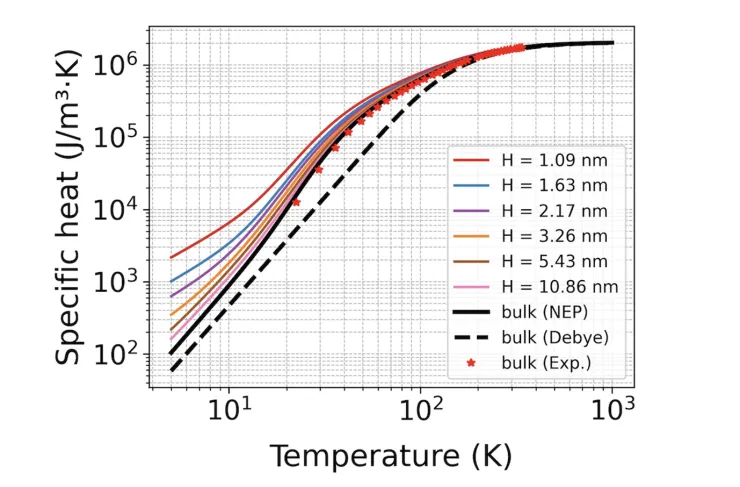
Temperature Dependence of Specific Heat Capacity of Nanostructures via Neuroevolution Machine-learned Potential
Journal of Applied Physics, 2025, Vol. 138, 104301
- IF 2.5
- JCR Q2
- Scopus Q2
Abstract
In this study, lattice dynamics calculations based on the Neuroevolution Machine-learned Potential (NEP) were performed for three types of silicon nanostructures: thin films, nanowires, and quantum dots. The temperature and size dependence of the specific heat capacity was systematically examined. The results reveal a significant enhancement in the specific heat capacity of nanostructures at low temperatures compared to bulk silicon, primarily due to phonon confinement, discrete energy spectra, and the emergence of low-frequency surface vibrational modes. These findings underscore the dominant role of nonlinear acoustic phonons at low temperatures, with increasing contributions from optical modes as the temperature rises. Notably, this work reports the temperature-dependent evolution of local fitting exponents in the specific heat scaling relation $C_v \sim T^{n(T)}$ for nanostructured systems. The high accuracy and computational efficiency of the NEP model allow for detailed characterization of the complex phonon behaviors that govern thermal properties at the nanoscale.
BibTeX
@article{shixian2025jap,
  author={Liu, Shixian and Zhang, Ge and Yin, Fei and Barinov, A.A. and Khvesyuk, V.I. and Yang, Nuo},
  title={Temperature Dependence of Specific Heat Capacity of Nanostructures via Neuroevolution Machine-learned Potential},
  journal={Journal of Applied Physics},
  volume={138},
  pages={104301},
  year={2025},
  doi={10.1063/5.0284002}
}
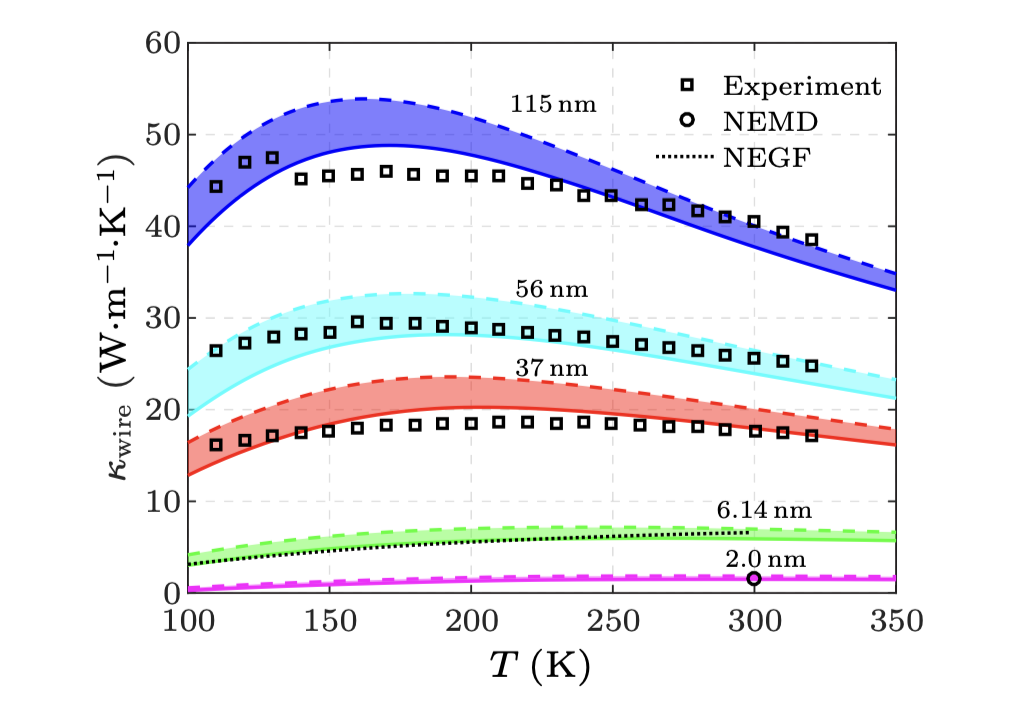
Determination of Thermal Properties of Unsmooth Si Nanowires
Chinese Physics Letters, 2024, Vol. 41, No. 1, 016301
- IF 4.2
- JCR Q1
- Scopus Q1
Abstract
We estimate the thermal properties of unsmooth Si nanowires, considering key factors such as size (diameter), surface texture (roughness) and quantum size effects (phonon states) at different temperatures. For nanowires with a diameter of less than 20 nm, we highlight the importance of quantum size effects in heat capacity calculations, using dispersion relations derived from the modified frequency equation for the elasticity of a rod. The thermal conductivities of nanowires with diameters of 37, 56, and 115nm are predicted using the Fuchs– Sondheimer model and Soffer’s specular parameter. Notably, the roughness parameters are chosen to reflect the technological characteristics of the real surfaces. Our findings reveal that surface texture plays a significant role in thermal conductivity, particularly in the realm of ballistic heat transfer within nanowires. This study provides practical recommendations for developing new thermal management materials.
BibTeX
@article{shixian2024determination,
  author={Liu, Shixian and Barinov, A.A. and Yin, Fei and Khvesyuk, V.I.},
  title={Determination of Thermal Properties of Unsmooth Si Nanowires},
  journal={Chinese Physics Letters},
  volume={41},
  number={1},
  pages={016301},
  year={2024},
  doi={10.1088/0256-307X/41/1/016301}
}