Research output
Publications
Browse published papers and citation data.
Google Scholar metrics updated October 26, 2026.
2027
1 paper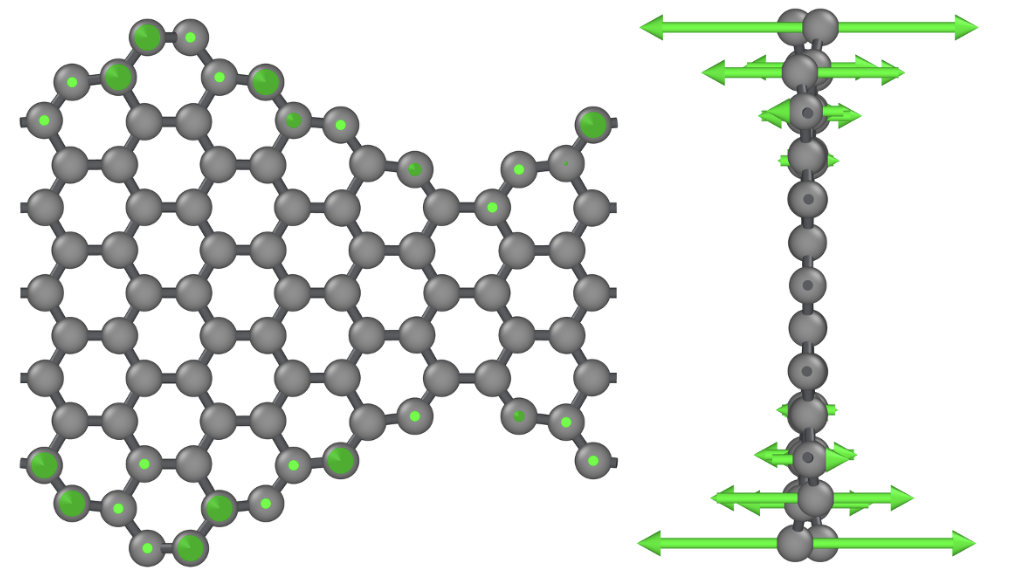
Cove-edge-induced vibrational confinement and weakened collective phonon transport in graphene nanoribbons
International Journal of Thermal Sciences, 2027, Vol. 233, 111381
Abstract
Periodic cove edges alter heat conduction in graphene nanoribbons in ways that are not fully captured by geometric boundary scattering. We investigate this effect using a graphene-nanoribbon-specific neuroevolution potential together with molecular dynamics, phonon Monte Carlo simulations, lattice dynamics, and full linearized phonon Boltzmann transport calculations. Cove-edged graphene nanoribbons exhibit lower thermal conductivity than pristine armchair nanoribbons over the length and width ranges considered. The conductivity reduction obtained from molecular dynamics is larger than that predicted by the semiclassical Monte Carlo model. The residual fraction is greatest at short lengths and small widths, whereas the Monte Carlo boundary contribution becomes relatively more important as either dimension increases. Participation ratios and real-space eigenvectors identify partially confined and strongly edge-confined modes in the low- and intermediate-frequency ranges. The cove-edged ribbons also show a smaller full-LBTE correction to the relaxation-time approximation and a lower transport-weighted Normal-to-Umklapp scattering-rate ratio. These results indicate that cove-edge patterning changes both the vibrational eigenstates and the intrinsic scattering balance, thereby reducing the mode-coupling correction beyond the independent-mode approximation.
BibTeX
@article{yin2026cove,
  author={Yin, Fei and Wang, Gang and Barinov, Alexander A. and Liu, Shixian and Xu, Ke},
  title={Cove-edge-induced vibrational confinement and weakened collective phonon transport in graphene nanoribbons},
  journal={International Journal of Thermal Sciences},
  volume={233},
  pages={111381},
  year={2027},
  doi={10.1016/j.ijthermalsci.2026.111381},
  url={https://www.sciencedirect.com/science/article/abs/pii/S1290072926007258}
}
2026
9 papers
NEP-kappa 2.0: A unified framework for phonon transport and nonequilibrium thermalization with machine-learning interatomic potentials
arXiv preprint, 2026
Abstract
We present NEP-kappa 2.0, a unified framework that integrates density-functional theory, material-specific machine-learning interatomic potentials, and pretrained force models for advanced phonon calculations. A common workflow enables harmonic lattice dynamics, quasi-harmonic and stochastic self-consistent phonon treatments, three- and four-phonon transport, Wigner population--coherence transport, and time-dependent phonon dynamics. Applications to 3C-SiC, BAs, and Cs$_2$AgInCl$_6$ demonstrate consistent force-model comparisons, finite-temperature renormalization, higher-order scattering, and intermode coherence. Beyond steady-state transport, mode-resolved simulations of selectively excited 3C-SiC reveal that half of the injected optical-phonon energy reaches acoustic modes within approximately 3.75 ps, primarily through one-optical--two-acoustic scattering. Acoustic branches exhibit response times differing by a factor of five, with competing scattering channels producing a transient energy overshoot. Channel-resolved entropy production and persistent nonthermal occupations distinguish interbranch energy redistribution from intrabranch thermalization. The framework connects equilibrium phonon transport with microscopic nonequilibrium energy dynamics.
BibTeX
@misc{liu2026nepkappa,
  author={Liu, Shixian and Liu, Bin and Yin, Fei and Wang, Gang and Dong, Yiming and Qin, Yangjun and Kosyakova, Alexandra V. and Xian, Qiang and Barinov, Alexander A. and Xu, Ke and Zhang, Gang},
  title={NEP-kappa 2.0: A unified framework for phonon transport and nonequilibrium thermalization with machine-learning interatomic potentials},
  journal={arXiv preprint},
  year={2026},
  doi={10.48550/arXiv.2610.25477},
  eprint={2610.25477},
  archivePrefix={arXiv},
  primaryClass={cond-mat.mtrl-sci},
  url={https://arxiv.org/abs/2610.25477}
}
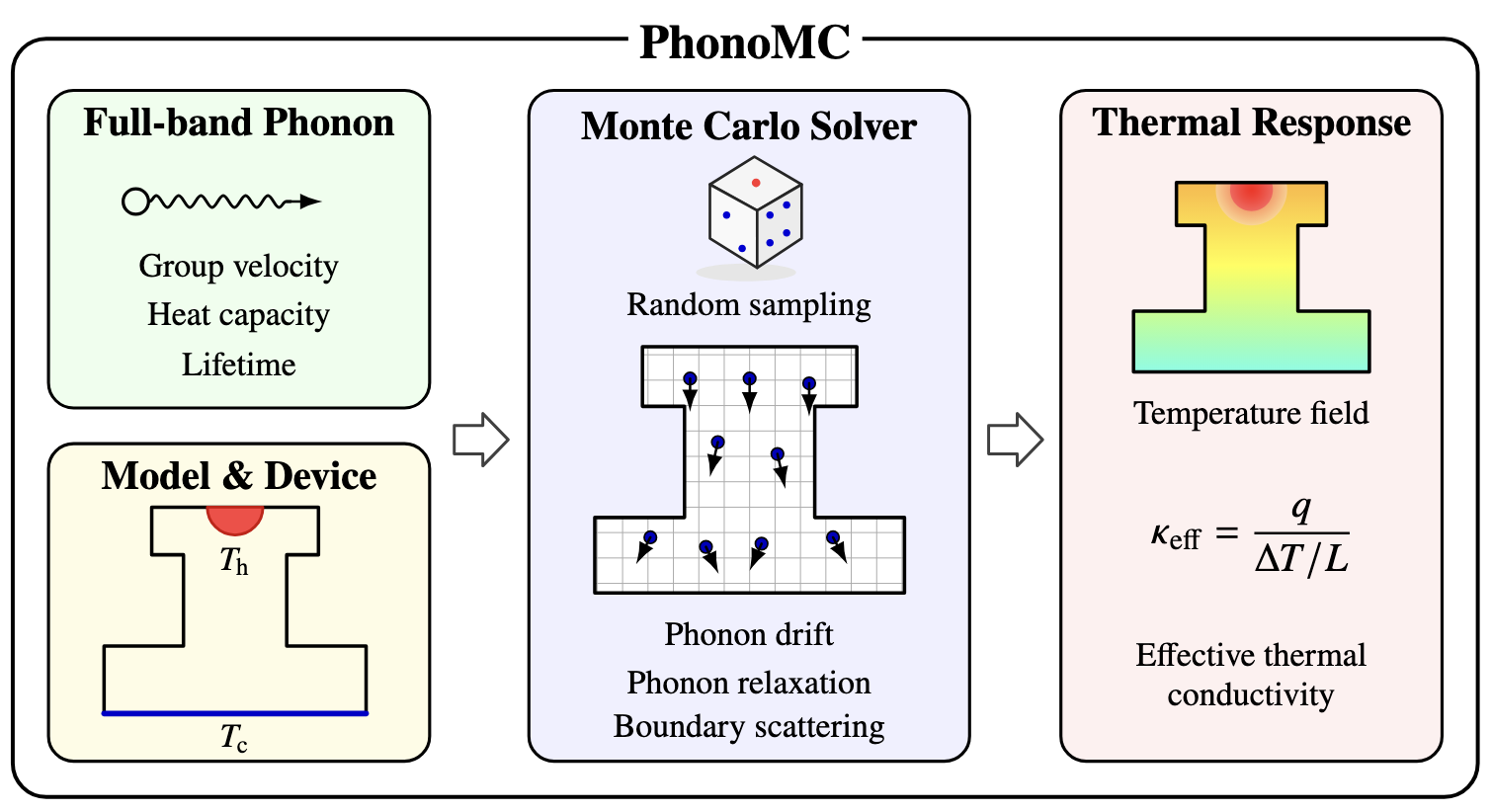
PhonoMC: Occupation-based deviational Monte Carlo for phonon transport with temperature-dependent scattering
arXiv preprint, 2026
Abstract
Nanoscale self-heating involves phonon transport across confined geometries, material interfaces, and temperature fields over which the scattering rates can vary substantially. We develop PhonoMC, an occupation-based deviational Monte Carlo method for solving the phonon Boltzmann transport equation within the relaxation-time approximation. A fixed equilibrium state is retained as the deviational reference, while the local temperature reconstructed from the represented energy is used to evaluate mode-dependent scattering rates. Collisions are updated with a separately determined relaxation temperature to conserve energy over each time step, and prescribed lattice heating is introduced by changing carrier occupations rather than continuously adding computational particles. For cross-plane transport through a 100-nm Si film, the deviational formulation reproduces the full-population heat flux while reducing its standard deviation by a factor of approximately 3.3 at $\Delta T=100$ K with $10^5$ carriers. In contrast, keeping the scattering rates fixed at 300 K overestimates the heat flux by 23.7% at $\Delta T=250$ K. Calculations of Si thin films distinguish finite-length effects from surface-scattering suppression, and Si/3C-SiC bilayers are used to examine interfacial thermal resistance. The method is further applied to localized heating in FinFET-like structures, where replacing the lower Si substrate with higher-conductivity 3C-SiC leads to a higher hotspot temperature because of the additional resistance associated with the confined Si region and the Si/SiC interface. These results show that a fixed deviational reference can be combined with local temperature-dependent scattering and sustained heat deposition in a mode-resolved Monte Carlo description of nanoscale thermal transport.
BibTeX
@misc{liu2026phonomc,
  author={Liu, Shixian and Yin, Fei and Wang, Gang and Liu, Bin and Zhang, Ge and Barinov, Alexander A. and Xu, Ke},
  title={PhonoMC: Occupation-based deviational Monte Carlo for phonon transport with temperature-dependent scattering},
  journal={arXiv preprint},
  year={2026},
  doi={10.48550/arXiv.2609.21884},
  eprint={2609.21884},
  archivePrefix={arXiv},
  primaryClass={cond-mat.mtrl-sci},
  url={https://arxiv.org/abs/2609.21884}
}

Knudsen-Controlled Switching of Thermal Conductivity Response by Targeted Phonon Excitation
arXiv preprint, 2026
Abstract
Targeted phonon excitation offers a route to dynamically control heat conduction, yet no general principle predicts whether a spectrally selective nonequilibrium phonon population will enhance or suppress thermal transport. A Knudsen-controlled competition between the increased contribution of long-mean-free-path phonons and excitation-enhanced intrinsic scattering governs the sign of the thermal-conductivity response. First-principles three-phonon scattering rates combined with phonon-tracking Monte Carlo simulations are used to examine Ge, Si, and 3C--SiC from bulk crystals to confined nanofilms. In bulk systems, excitation-enhanced scattering dominates and thermal conductivity is predominantly suppressed. In nanofilms, by contrast, low-frequency excitation can increase the contribution of quasi-ballistic heat-carrying channels and enhance thermal conductivity, whereas higher-frequency excitation is predominantly suppressive. At fixed background temperature and excitation strength, these opposite responses are organized in a frequency--Knudsen map based on the normalized target frequency, $\omega_{\mathrm t}/\omega_{\mathrm D}$, and the Knudsen number, $\mathrm{Kn}$. The resulting framework provides a general physical basis for controlling nonequilibrium heat transport beyond static phonon engineering.
BibTeX
@misc{liu2026excitation,
  author={Shixian Liu and Tianhao Li and Fei Yin and Yu He and Alexander A. Barinov and Han Meng and Yang, Nuo},
  title={Knudsen-Controlled Switching of Thermal Conductivity Response by Targeted Phonon Excitation},
  journal={arXiv preprint},
  year={2026},
  doi={10.48550/arXiv.2607.28905},
  eprint={2607.28905},
  archivePrefix={arXiv},
  primaryClass={cond-mat.mtrl-sci},
  url={https://arxiv.org/abs/2607.28905}
}
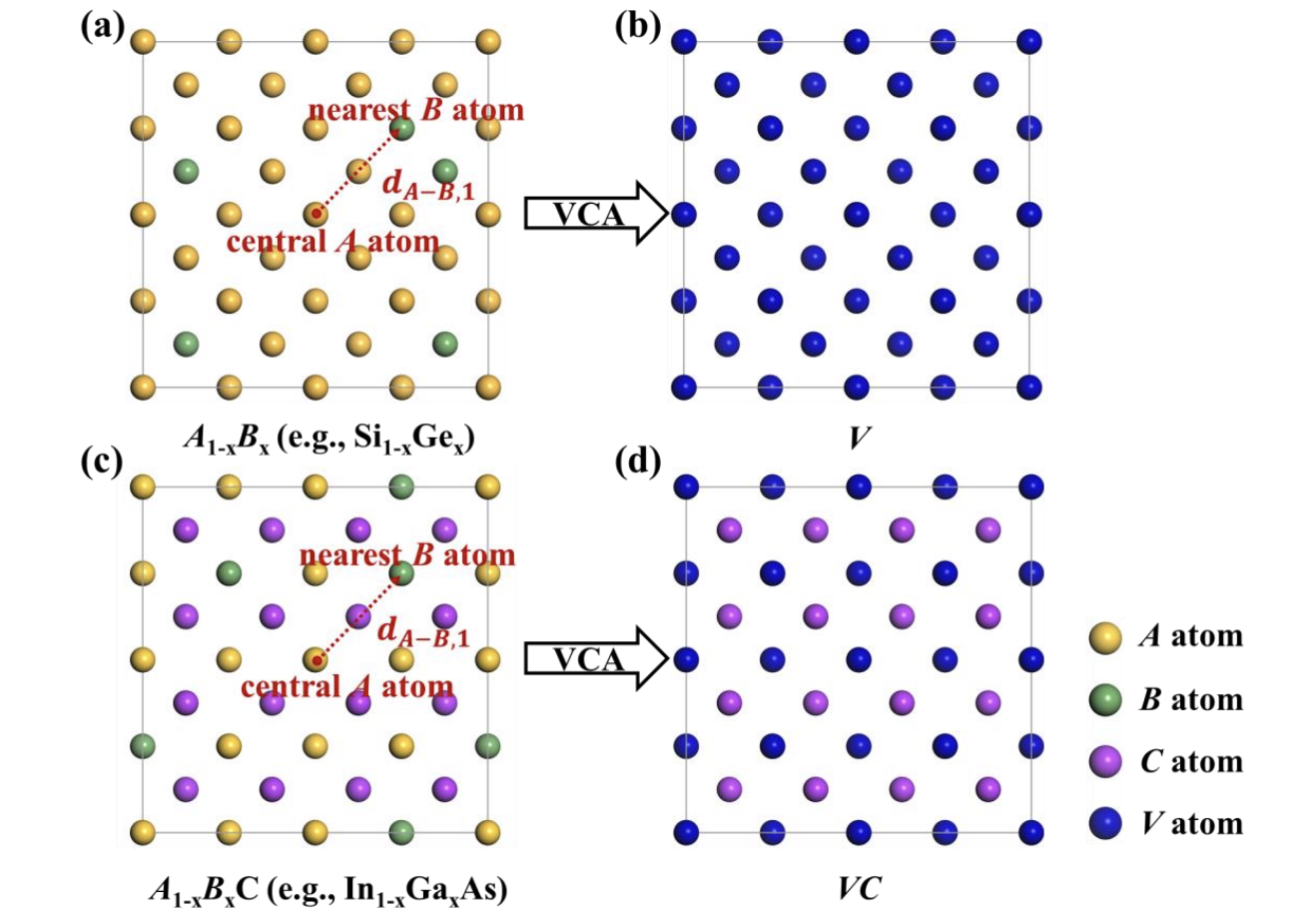
The substitutional atomic distance model for predicting lattice thermal conductivity in alloys
arXiv preprint, 2026
Abstract
Understanding phonon transport in alloys is crucial for the design of high-performance electronic and thermoelectric devices. However, conventional theoretical models fail to provide a clear physical picture of phonon scattering caused by atomic disorder in alloys, and their prediction accuracy is limited. In this work, a new substitutional atomic distance model for alloys is proposed, providing an intuitive physical picture. SiGe and InGaAs alloys are taken as representative systems, and their thermal conductivities are calculated, showing good agreement with previous experimental measurements. The results indicate that alloy scattering plays a dominant role in reducing thermal conductivity. This study provides new insights into phonon transport in alloys and offers guidance for tailoring thermal properties through compositional engineering.
BibTeX
@misc{zong2026alloy,
  author={Zong, Zhicheng and Li, Tianhao and Liu, Shixian and Fang, Haisheng and Yang, Nuo},
  title={The substitutional atomic distance model for predicting lattice thermal conductivity in alloys},
  journal={arXiv preprint},
  year={2026},
  doi={10.48550/arXiv.2606.29747},
  eprint={2606.29747},
  archivePrefix={arXiv},
  primaryClass={cond-mat.mtrl-sci},
  url={https://arxiv.org/abs/2606.29747}
}
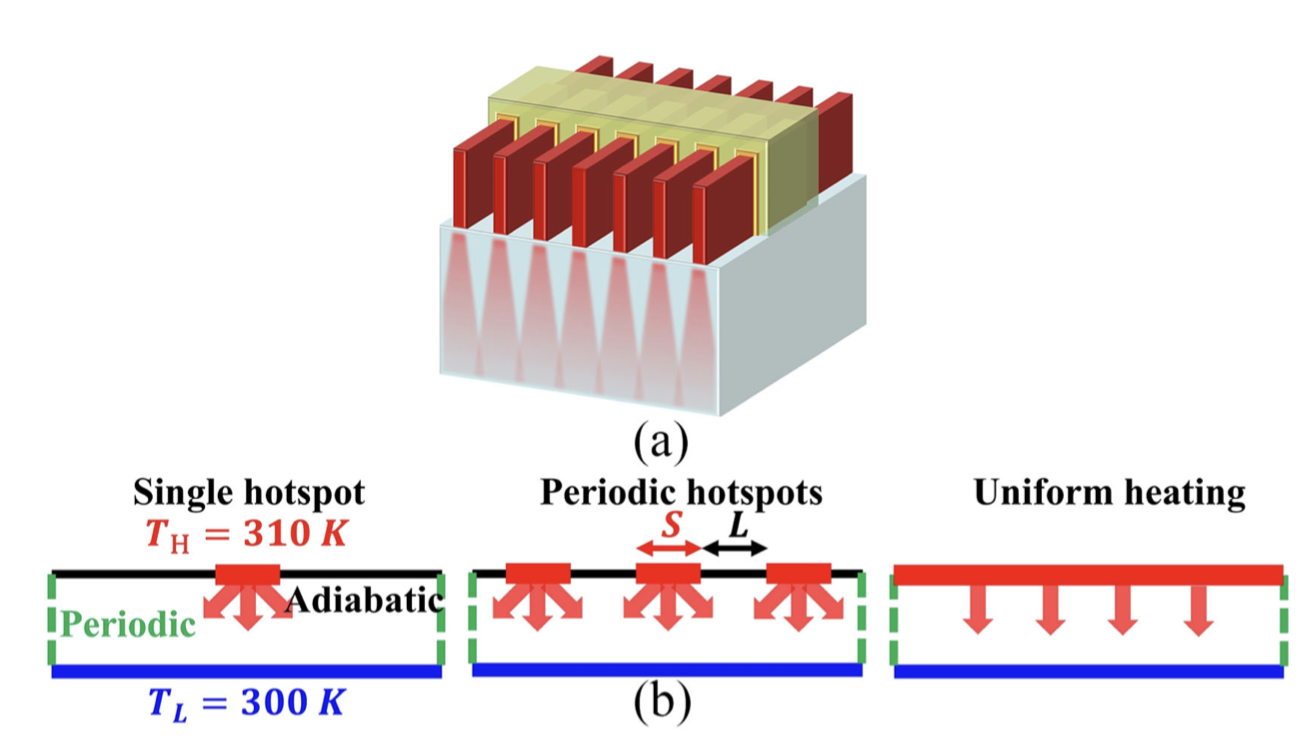
Nonuniform Thermal Conductivity in Nanoscale Multiple Hotspot Systems
Physical Review Letters, 2026, Vol. 137, No. 15, 156303
Abstract
Nanoscale hotspot thermal transport is critical for thermal management of electronic devices. Here, the thermal transport in nanoscale multiple hotspots is investigated by solving the phonon Boltzmann transport equation. To address the limitations of the conventional black-box treatment, a formal local thermal conductivity is proposed, which extends the classical framework to nanoscale nondiffusive regimes. The results reveal a highly nonuniform local thermal transport capability with up to a 13-fold variation across the system. A substantial heat flux deflection is also observed, which significantly deviates from the direction predicted by Fourier's law. Furthermore, closely spaced nanoscale hotspots are found to enhance heat flux by up to 40%. This enhancement arises from a mechanism in which diffuse boundary scattering at hotspot spacing regions can enhance rather than impede thermal transport. This Letter challenges the long-standing black-box treatment of nanoscale thermal transport and offers fundamental insights for the thermal management of high-power-density integrated circuits.
BibTeX
@article{he2026hotspot,
  author={He, Yu and Zhou, Zhihao and Liu, Shixian and Lü, Jing-Tao and Yang, Lina and Yang, Nuo},
  title={Nonuniform Thermal Conductivity in Nanoscale Multiple Hotspot Systems},
  journal={Physical Review Letters},
  volume={137},
  number={15},
  pages={156303},
  year={2026},
  doi={10.1103/g549-tkdc},
  eprint={2511.21070},
  archivePrefix={arXiv},
  primaryClass={cond-mat.mes-hall},
  url={https://doi.org/10.1103/g549-tkdc}
}
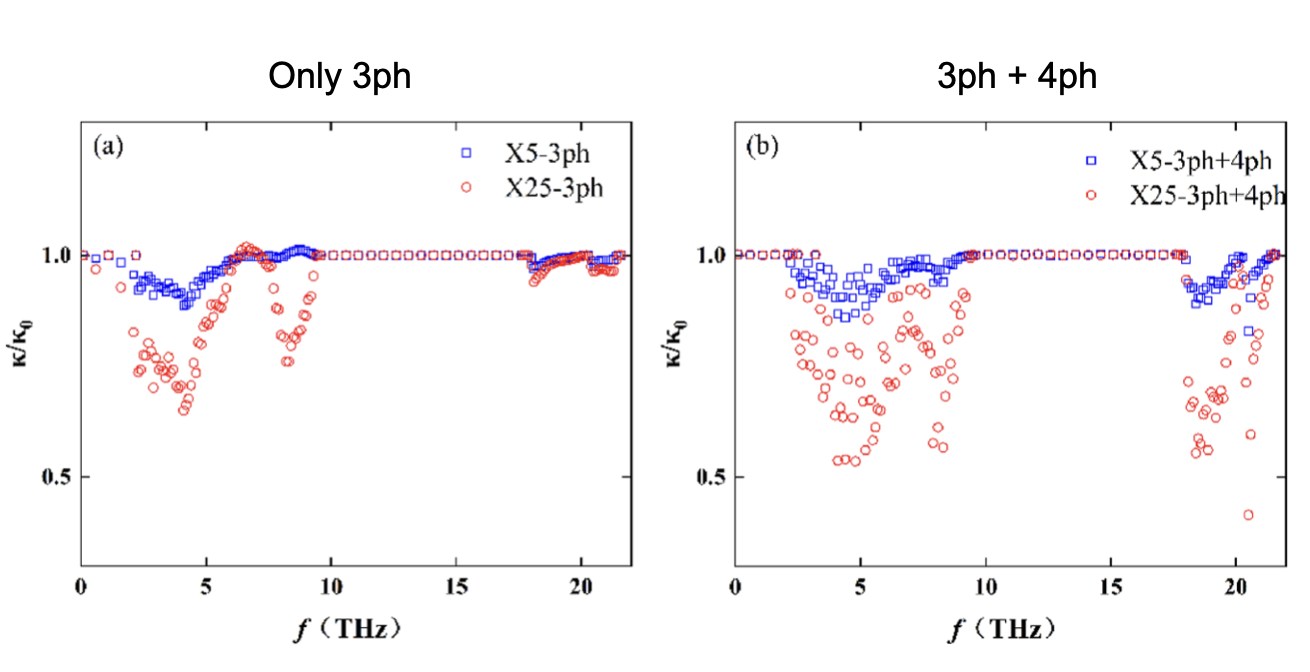
Higher-order-phonon scattering governs targeted control of heat conduction in bulk boron arsenide
Materials Today Physics, 2026, Vol. 68, 102236
Abstract
Using boron arsenide as a physically motivated case study, we reveal the role of higher-order phonon scattering in thermal conductivity modulation through targeted phonon excitation. Using first-principles calculations and phonon Boltzmann transport analysis, it is found that targeted phonon excitation induces strongly frequency-dependent thermal-conductivity responses in bulk boron arsenide. Within the three-phonon-only framework, the modulation effect at 300 K is weak, with only marginal enhancement tendencies observed when exciting phonons in a narrower frequency range of 6.4–7.0 THz. However, in the combined three- and four-phonon scattering framework, the response changes toward suppressive modulation. The strongest suppression occurs at 20.5 THz, with relative thermal conductivity dropping to 0.828 and 0.415 for occupation multipliers of 5 and 25, respectively. The scattering-rate analysis reveals that four-phonon scattering elevates the intrinsic scattering background and enhances population-modification-induced scattering of low-frequency heat-carrying phonons. Furthermore, comparing 300 K and 100 K shows that lowering temperature weakens the contribution of four-phonon scattering and partially restores three-phonon-like modulation features. These findings provide mechanistic insight into the role of higher-order phonon scattering in targeted phonon-population control of bulk boron arsenide and advance the understanding of phonon-based thermal modulation in bulk anharmonic materials.
BibTeX
@article{li2026bas,
  author={Li, Tianhao and Qin, Yangjun and Pan, Dongkai and Liu, Shixian and Meng, Han and Yang, Nuo},
  title={Higher-order-phonon scattering governs targeted control of heat conduction in bulk boron arsenide},
  journal={Materials Today Physics},
  volume={68},
  pages={102236},
  year={2026},
  month={nov},
  doi={10.1016/j.mtphys.2026.102236},
  eprint={2510.07934},
  archivePrefix={arXiv},
  primaryClass={cond-mat.mtrl-sci},
  url={https://www.sciencedirect.com/science/article/abs/pii/S2542529326002270}
}

Quantitatively analyzing microscopic mechanism of phonon coupling in nanostructured diamond
Chinese Physics B, 2026
Abstract
By combining nonequilibrium molecular dynamics, the spectral phonon temperature method, and the phonon weak-coupling model, we quantify the coupling between longitudinal and transverse phonon mode groups in nanostructured diamond. At 300 K and a system length of approximately 35 nm, the selected LP and TP modes along $\Gamma$--X retain a resolvable temperature difference, yielding a coupling length of 130 $\pm$ 34 nm and indicating weak coupling. From 300 to 700 K, the coupling length decreases overall with increasing temperature, whereas above 700 K the temperature difference becomes too small for stable PWCM fitting. The coupling length increases with system length, which may mainly arise from the size dependence of thermal conductivity. These results demonstrate that distinct phonon mode groups in high-thermal-conductivity diamond can remain in local thermal nonequilibrium over nanoscale distances. These results characterize branch-resolved thermal nonequilibrium in nanostructured diamond.
BibTeX
@article{liang2026cpb,
  author={Liang, Wu and Liu, Shixian and Meng, Han and Yang, Nuo},
  title={Quantitatively analyzing microscopic mechanism of phonon coupling in nanostructured diamond},
  journal={Chinese Physics B},
  year={2026},
  doi={10.1088/1674-1056/aea3dd},
  url={https://cpb.iphy.ac.cn/article/doi/10.1088/1674-1056/aea3dd}
}
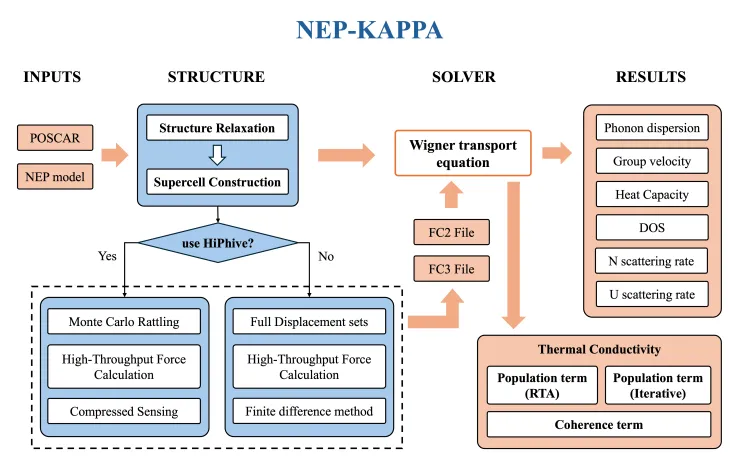
Accelerated phonon transport calculations for nanostructures: Combining neuroevolution potentials and compressed sensing
Journal of Applied Physics, 2026, Vol. 139, 135103
Abstract
Thermal management in nanostructured devices necessitates the accurate and efficient prediction of phonon transport properties. However, solving the Boltzmann transport equation via first-principles calculations is often computationally prohibitive due to the extensive supercells required to model realistic nanostructures. In this work, we present an accelerated, automated workflow that synergizes neuroevolution potentials with compressed sensing techniques to efficiently extract high-order anharmonic force constants. We validate this approach using silicon thin films as a prototype, explicitly accounting for the complexities of surface reconstruction. Our results demonstrate that this framework achieves accuracy comparable to density functional theory while reducing the computational cost by several orders of magnitude. The workflow successfully reproduces phonon dispersion relations and captures the temperature- and size-dependent trends of lattice thermal conductivity, incorporating the critical contribution of inter-mode coherence. This methodology offers a scalable and robust solution for the high-throughput thermal characterization of low-dimensional materials.
BibTeX
@article{fei2026jap,
  author={Yin, Fei and Liu, Shixian and Dong, Yiming and Barinov, A.A. and Xu, Ke and Khvesyuk, V.I.},
  title={Accelerated phonon transport calculations for nanostructures: Combining neuroevolution potentials and compressed sensing},
  journal={Journal of Applied Physics},
  volume={139},
  pages={135103},
  year={2026},
  doi={10.1063/5.0324012}
}
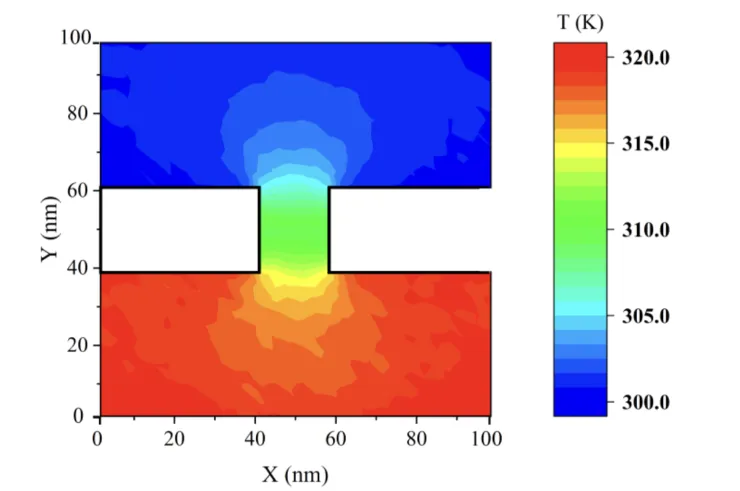
Effect of Non-Fourier Heat Transport on Temperature Distribution in High Bandwidth Memory
IEEE Transactions on Electron Devices, 2026, Vol. 73, 561-568
Abstract
High Bandwidth Memory, as a key development trend in future memory chip technology, significantly enhances computer performance. At the same time, the thermal challenges arising from its stacked architecture have drawn considerable attention. Most existing studies on thermal management of high bandwidth memory are based on Fourier's law, neglecting the non-Fourier effects introduced by the micro/nanoscale structures. In this study, the Monte Carlo method is employed to solve the phonon Boltzmann transport equation and investigate the impact of non-Fourier heat transport on the thermal behavior of high bandwidth memory structures. The results reveal that non-Fourier heat transport leads to a junction temperature that is 59.8 K higher than that predicted by Fourier's law. Furthermore, it is found that the phonon transmittance at the chip interlayers has a severe impact on heat dissipation, with the temperature variation reaching up to 56.6 K. These findings provide more accurate thermal insights, which are critical for the optimized design of high bandwidth memory systems.
BibTeX
@article{zhihao2025hbm,
  author={Zhou, Zhihao and He, Yu and Liu, Shixian and Yang, Lina and Yang, Nuo},
  title={Effect of Non-Fourier Heat Transport on Temperature Distribution in High Bandwidth Memory},
  journal={IEEE Transactions on Electron Devices},
  volume={73},
  pages={561-568},
  year={2026},
  doi={10.1109/TED.2025.3628342}
}
2025
5 papers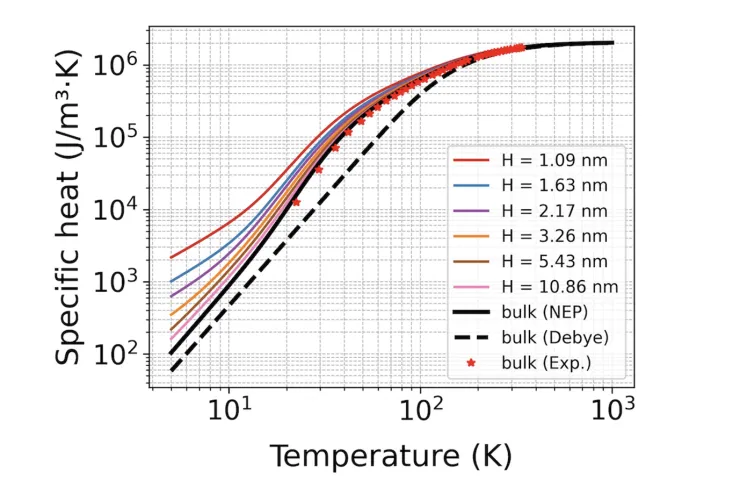
Temperature Dependence of Specific Heat Capacity of Nanostructures via Neuroevolution Machine-learned Potential
Journal of Applied Physics, 2025, Vol. 138, 104301
Abstract
In this study, lattice dynamics calculations based on the Neuroevolution Machine-learned Potential (NEP) were performed for three types of silicon nanostructures: thin films, nanowires, and quantum dots. The temperature and size dependence of the specific heat capacity was systematically examined. The results reveal a significant enhancement in the specific heat capacity of nanostructures at low temperatures compared to bulk silicon, primarily due to phonon confinement, discrete energy spectra, and the emergence of low-frequency surface vibrational modes. These findings underscore the dominant role of nonlinear acoustic phonons at low temperatures, with increasing contributions from optical modes as the temperature rises. Notably, this work reports the temperature-dependent evolution of local fitting exponents in the specific heat scaling relation $C_v \sim T^{n(T)}$ for nanostructured systems. The high accuracy and computational efficiency of the NEP model allow for detailed characterization of the complex phonon behaviors that govern thermal properties at the nanoscale.
BibTeX
@article{shixian2025jap,
  author={Liu, Shixian and Zhang, Ge and Yin, Fei and Barinov, A.A. and Khvesyuk, V.I. and Yang, Nuo},
  title={Temperature Dependence of Specific Heat Capacity of Nanostructures via Neuroevolution Machine-learned Potential},
  journal={Journal of Applied Physics},
  volume={138},
  pages={104301},
  year={2025},
  doi={10.1063/5.0284002}
}
An Enhanced Framework for Wave Reflection from a Periodically Rough Boundary
Physica B: Condensed Matter, 2025, Vol. 716, 417743
Abstract
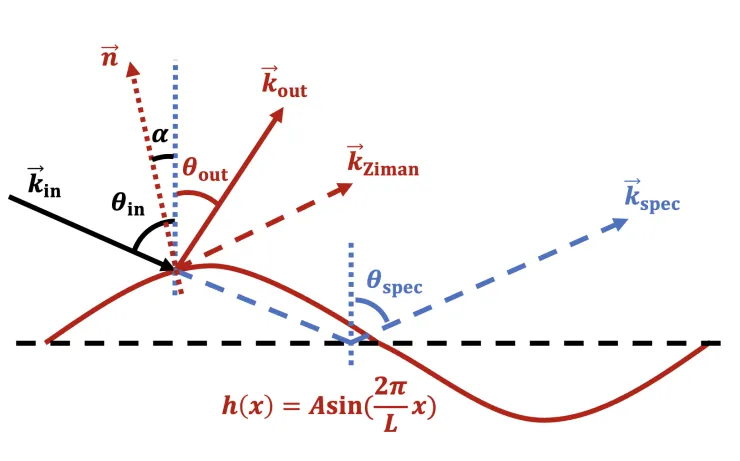
This paper presents an updated comprehensive model for specular reflection from a periodically rough boundary. The model accounts for both phase loss and angular deviations of the reflected wave, enabling a statistical evaluation of the specular reflection probability as a function of wavelength, roughness amplitude, roughness period, and incident angle. Notably, the model reveals oscillatory behavior in the specular reflection probability within the high-frequency regime. The proposed formulation is further incorporated into the Ziman model and applied in Monte Carlo simulations to evaluate thermal conductivity.
BibTeX
@article{yin2025pb,
  author={Yin, Fei and Liu, Shixian and Barinov, A.A. and Khvesyuk, V.I.},
  title={An Enhanced Framework for Wave Reflection from a Periodically Rough Boundary},
  journal={Physica B: Condensed Matter},
  volume={716},
  pages={417743},
  year={2025},
  doi={10.1016/j.physb.2025.417743}
}
Quantifying Particle and Wave Effects in Phonon Transport of Pillared Graphene Nanoribbons
International Journal of Thermal Sciences, 2025, Vol. 217, 110067
Abstract
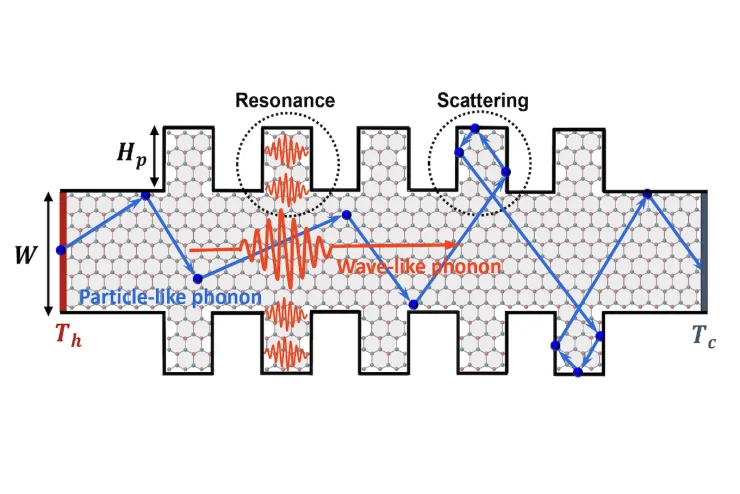
This study investigates the dual nature of phonons—encompassing both particle-like and wave-like behaviors—and their roles in thermal transport within pillared graphene nanoribbons (PGNRs). Monte Carlo simulations are employed to evaluate how the presence of pillars affects the thermal conductivity of graphene nanoribbons (GNRs), revealing that pillars significantly reduce thermal conductivity by enhancing phonon-boundary scattering, thereby emphasizing particle effects. A comparison with molecular dynamics simulations enables quantitative assessment of the respective contributions of particle and wave phenomena to the observed reduction in thermal conductivity. Notably, as the width of PGNRs decreases, the influence of wave effects initially increases and then diminishes, suggesting a saturation behavior. Furthermore, this study introduces and evaluates the concept of phonon resonance hybridization depth in PGNRs.
BibTeX
@article{shixian2025wave,
  author={Liu, Shixian and Zong, Zhicheng and Yin, Fei and Khvesyuk, V.I. and Yang, Nuo},
  title={Quantifying Particle and Wave Effects in Phonon Transport of Pillared Graphene Nanoribbons},
  journal={International Journal of Thermal Sciences},
  volume={217},
  pages={110067},
  year={2025},
  doi={10.1016/j.ijthermalsci.2025.110067}
}
Temperature Fluctuations in Quantum Dots: Insights from a \(T^{3/2}\) Heat Capacity Model
Physics Letters A, 2025, Vol. 534, 130261
Abstract
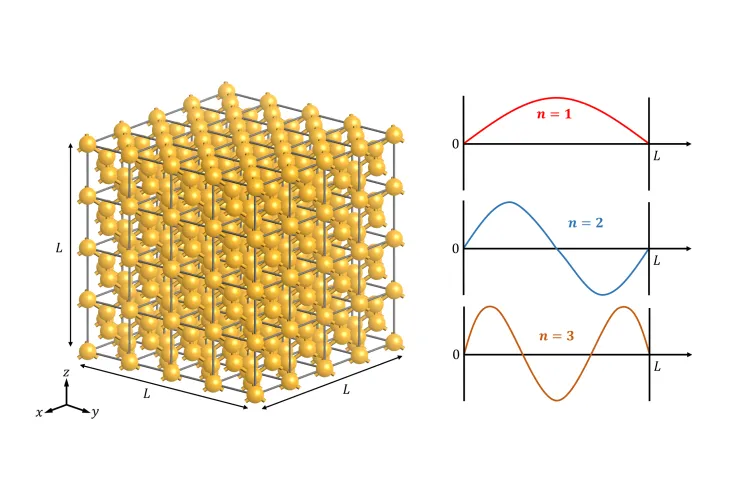
In this study, the temperature fluctuations in three-dimensional confined nanostructures (quantum dots) of germanium, silicon, and diamond were calculated using the \(T^{3/2}\) model based on the particle-in-a-box (PIAB) approach and compared with the Debye \(T^3\) model. The analysis focused on quantum dots with sizes ranging from 1 to 100 nm. According to the PIAB \(T^{3/2}\) model, temperature fluctuations decrease as the temperature decreases, consistent with the principles of statistical physics. In contrast, the Debye \(T^3\) model predicts an increase in temperature fluctuations with decreasing temperature, contradicting the principles of statistical physics. These results emphasize the significant impact of quantum confinement and highlight the limitations of the Debye \(T^3\) model in describing nanoscale systems. Furthermore, distribution diagrams illustrating temperature fluctuations as functions of size and temperature were established for the first time. Based on these diagrams, clear boundaries were defined for the temperature and thermophysical property ranges where reliable predictions can be made.
BibTeX
@article{shixian2025fluctuation,
  author={Liu, Shixian and Khvesyuk, V.I.},
  title={Temperature Fluctuations in Quantum Dots: Insights from a \(T^{3/2}\) Heat Capacity Model},
  journal={Physics Letters A},
  volume={534},
  pages={130261},
  year={2025},
  doi={10.1016/j.physleta.2025.130261}
}
Investigating Anisotropic Three-Phonon Interactions in Graphene's Thermal Conductivity Using Monte Carlo Method
International Journal of Thermophysics, 2025, Vol. 46, No. 2, 22
Abstract
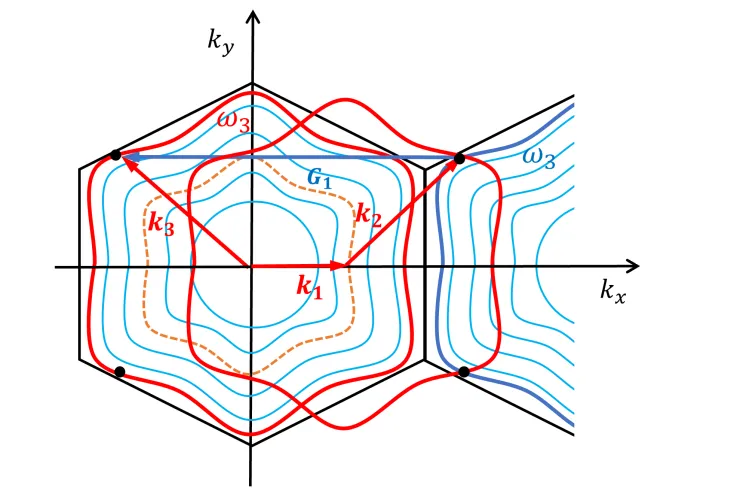
This study introduces a novel method for calculating the thermal conductivity of graphene using a Monte Carlo approach to evaluate anisotropic three-phonon interactions. The phonon dispersion relation is derived using a force constant model that incorporates up to fifth-order nearest-neighbor interactions, while the phonon density of states (DOS) is computed via a generalized Gilat-Raubenheimer method. A quantitative relationship for the scaling exponent of the specific heat capacity at low temperatures is established, emphasizing the unique two-dimensional characteristics of graphene. To address anisotropic effects, the Monte Carlo approach efficiently identifies three-phonon combinations that adhere to the conservation laws of energy and momentum. The findings highlight the pivotal role of anisotropic phonon interactions in graphene's thermal conductivity. The thermal conductivity values obtained through the iterative method exhibit strong agreement with previous three-phonon calculations, thereby validating the model. Nevertheless, discrepancies with experimental data suggest that incorporating higher-order phonon processes, such as four-phonon scattering, may further improve predictive accuracy.
BibTeX
@article{shixian2025graphene,
  author={Liu, Shixian and Yin, Fei and Khvesyuk, V.I.},
  title={Investigating Anisotropic Three-Phonon Interactions in Graphene's Thermal Conductivity Using Monte Carlo Method},
  journal={International Journal of Thermophysics},
  volume={46},
  number={2},
  pages={22},
  year={2025},
  doi={10.1007/s10765-024-03498-x}
}
2024
1 paper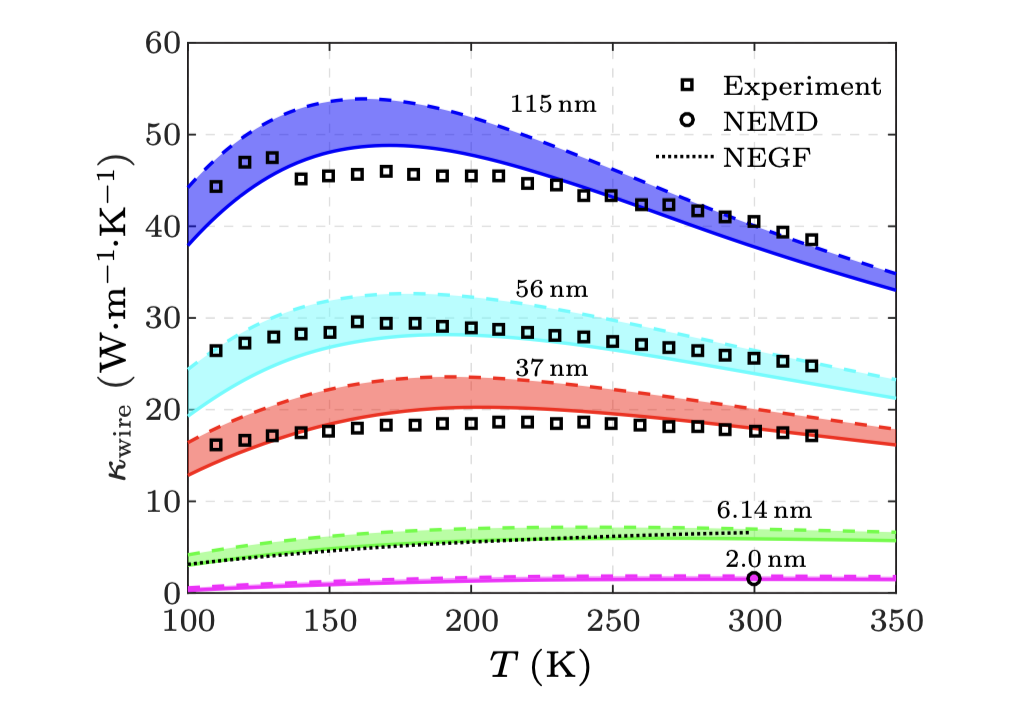
Determination of Thermal Properties of Unsmooth Si Nanowires
Chinese Physics Letters, 2024, Vol. 41, No. 1, 016301
Abstract
We estimate the thermal properties of unsmooth Si nanowires, considering key factors such as size (diameter), surface texture (roughness) and quantum size effects (phonon states) at different temperatures. For nanowires with a diameter of less than 20 nm, we highlight the importance of quantum size effects in heat capacity calculations, using dispersion relations derived from the modified frequency equation for the elasticity of a rod. The thermal conductivities of nanowires with diameters of 37, 56, and 115nm are predicted using the Fuchs– Sondheimer model and Soffer’s specular parameter. Notably, the roughness parameters are chosen to reflect the technological characteristics of the real surfaces. Our findings reveal that surface texture plays a significant role in thermal conductivity, particularly in the realm of ballistic heat transfer within nanowires. This study provides practical recommendations for developing new thermal management materials.
BibTeX
@article{shixian2024determination,
  author={Liu, Shixian and Barinov, A.A. and Yin, Fei and Khvesyuk, V.I.},
  title={Determination of Thermal Properties of Unsmooth Si Nanowires},
  journal={Chinese Physics Letters},
  volume={41},
  number={1},
  pages={016301},
  year={2024},
  doi={10.1088/0256-307X/41/1/016301}
}
2022
1 paper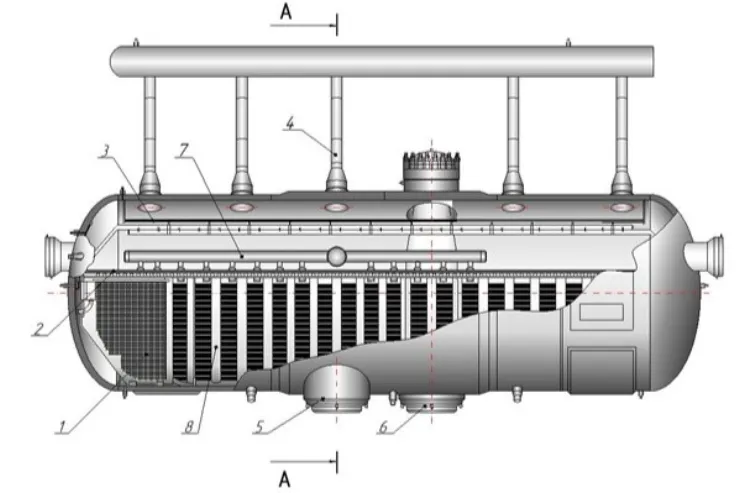
Validation of the STEG code using experiments on two-phase flow across horizontal tube bundles
Nuclear Engineering and Design, 2022, Vol. 399, 112048
Abstract
The results of the validation of the STEG code using the experiments on two-phase flow across horizontal tube bundles are presented. The experiments are carried out on two water–air SG models, consisting of a transparent vessels, inside of which there is a tube bundle, a perforated sheet and a bead separating the upstream section of the circulation circuit of the model from the downstream one. The void fractions and water velocities are measured in different locations of the models. The brief description of the STEG code based on the 3D two-fluid model is presented. A set of interfacial drag correlations, which was recently developed by the authors, are used in the validation calculations. The peculiarities of the spatial two-phase flows have been established, and a quantitative comparison with experimental data has been performed. Good agreement between the calculated and experimental data is obtained.
BibTeX
@article{liu2022validation,
  author={Liu, Shixian and Yin, Fei and Melikhov, V.I. and Melikhov, O.I.},
  title={Validation of the STEG code using experiments on two-phase flow across horizontal tube bundles},
  journal={Nuclear Engineering and Design},
  volume={399},
  pages={112048},
  year={2022},
  doi={10.1016/j.nucengdes.2022.112048}
}